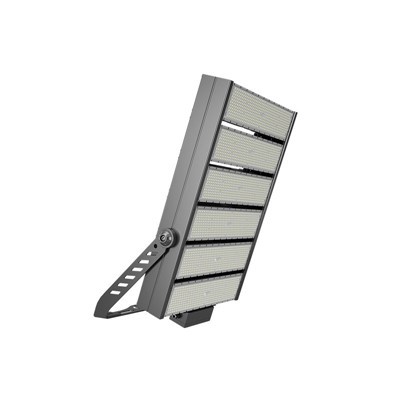

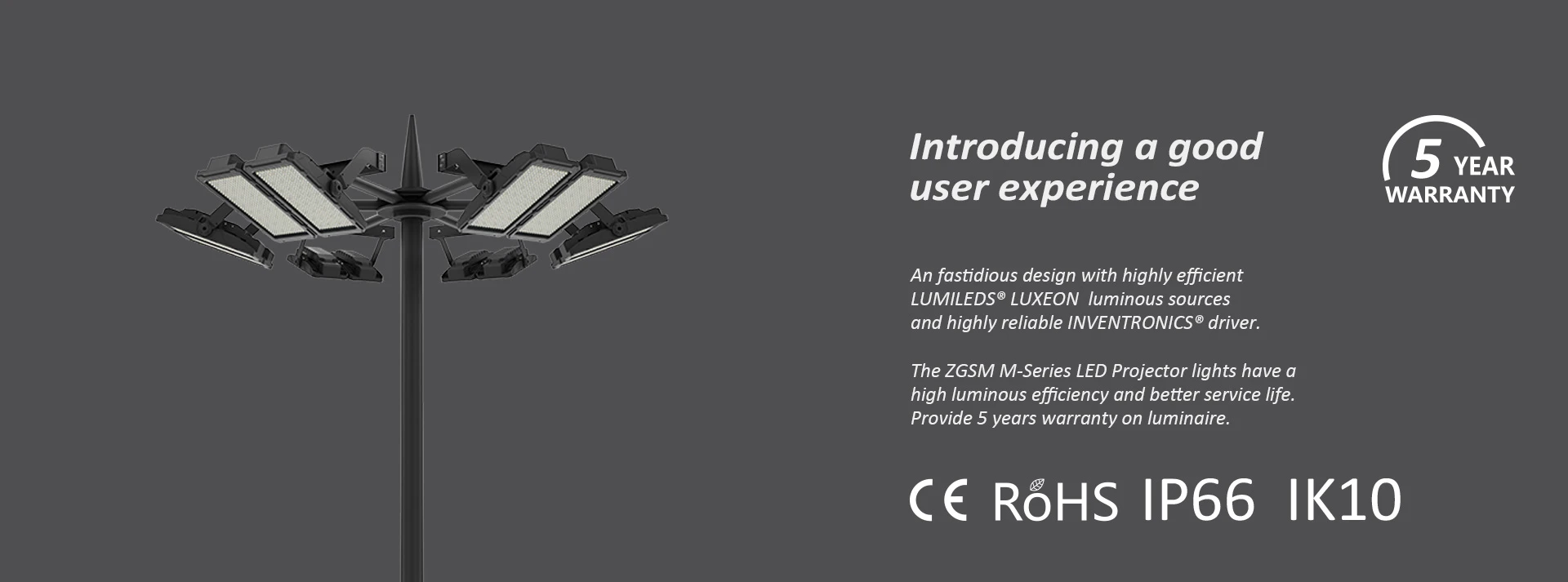
ZGSM Stadium Lights is optimized for customers requiring a LED solution for expressway, freeway interchanges, sports fields, airports and other large area applications. The modern design incorporates the big heat sink for heat transfer to prolong LED life. This reliable LED Sports Lighting has a 100,000-hour design life, significantly reducing maintenance needs and expense over the life of the fixture. This efficient solution lowers energy consumption compared to traditional HID fixture for additional operating cost savings.
ZGSM is a hi-tech and private Enterprise devoted to R&D, producing and selling of high quality LED indoor/outdoor lights, LED traffic lights, solar panels and solar powered LED lighting system and so on. As one of the patent model enterprises and the first batch of Energy-saving Service Company in Zhejiang Province, we have registered more than fifty products; we are also the members of Illuminating Engineering Society and Semiconductor Industry Association in China.
Why choose us?
Product application
Been widely used in indoor/outdoor lighting, city lighting, traffic instruction, solar power generation projects and other fields.
Our certificate
CE, GS, UL, RoHS, CB, ENEC, SAA, DLC, LM79, LM80, ISO9001, ISO14001, ISO50001, BSOHSAS18001.
Production market
Our products have been exported to more than 80 countries and regions.
Our service
Sales, technical and aftersales is 24hours on line for service.
-
![Football Field Led Stadium Light]() Football Field Led Stadium LightModel:ZGSM-TGD280M . Power:280 . Efficacy:150 lm/w . Lumen: 42000lm . PF>0.95 . THD70 .
Football Field Led Stadium LightModel:ZGSM-TGD280M . Power:280 . Efficacy:150 lm/w . Lumen: 42000lm . PF>0.95 . THD70 . -
![5 Years Warranty Led Stadium Lights]() 5 Years Warranty Led Stadium LightsModel:ZGSM-TGD840M . Power:840 . Efficacy:150lm/w . Lumen: 126000lm . PF>0.95 . THD70 .
5 Years Warranty Led Stadium LightsModel:ZGSM-TGD840M . Power:840 . Efficacy:150lm/w . Lumen: 126000lm . PF>0.95 . THD70 . -
![High Mast 840w Led Square Light]() High Mast 840w Led Square LightModel:ZGSM-TGD840M . Power:840 . Efficacy:150lm/w . Lumen: 126000lm . PF>0.95 . THD70 .
High Mast 840w Led Square LightModel:ZGSM-TGD840M . Power:840 . Efficacy:150lm/w . Lumen: 126000lm . PF>0.95 . THD70 . -
![High Brightness Led Stadium Light]() High Brightness Led Stadium LightModel:ZGSM-TGD280M . Power:280 . Efficacy:150lm/w . Lumen: 42000-12600lm . PF>0.95 . THD70 .
High Brightness Led Stadium LightModel:ZGSM-TGD280M . Power:280 . Efficacy:150lm/w . Lumen: 42000-12600lm . PF>0.95 . THD70 . -
![Waterproof Energy Saving LED Flood Light]() Waterproof Energy Saving LED Flood LightModel:ZGSM-TGD280M . Power:280 . Efficacy:150lm/w . Lumen: 42000-126000lm . PF>0.95 . THD70 .
Waterproof Energy Saving LED Flood LightModel:ZGSM-TGD280M . Power:280 . Efficacy:150lm/w . Lumen: 42000-126000lm . PF>0.95 . THD70 . -
![Waterproof 560W LED Stadium Light]() Waterproof 560W LED Stadium LightModel:ZGSM-TGD560M . Power:560 . Efficacy:150lm/w . Lumen: 84000lm . PF>0.95 . THD70 .
Waterproof 560W LED Stadium LightModel:ZGSM-TGD560M . Power:560 . Efficacy:150lm/w . Lumen: 84000lm . PF>0.95 . THD70 . -
![Sport court LED Stadium Lights]() Sport court LED Stadium LightsHigh mast lighting . High mounting height for storage, transportation, and pedestrian use and safety.. High mast fixtures are typically mounted on poles 40 feet to 150 feet tall,. Offen used by
Sport court LED Stadium LightsHigh mast lighting . High mounting height for storage, transportation, and pedestrian use and safety.. High mast fixtures are typically mounted on poles 40 feet to 150 feet tall,. Offen used by -
![DMX Dimmable LED Stadium Lights]() DMX Dimmable LED Stadium Lights150lm/W LED Stadium High Mast LightsGreater than 180lm/W Lumileds 3030 2D The whole fixture can be 0-360º adjustable, and the single module can be 0-90º adjustable.
DMX Dimmable LED Stadium Lights150lm/W LED Stadium High Mast LightsGreater than 180lm/W Lumileds 3030 2D The whole fixture can be 0-360º adjustable, and the single module can be 0-90º adjustable. -
![LED Stadium Light 560W For Soccer Field Football Court]() LED Stadium Light 560W For Soccer Field Football CourtLED high mast light outdoor flood light soccer field light1. LUMILEDS LUXEON® 3030 leds.2. Inventronics drivers with 0-10V dimming features.3. Five years warranty.4. High power range: 280W, 560W,
LED Stadium Light 560W For Soccer Field Football CourtLED high mast light outdoor flood light soccer field light1. LUMILEDS LUXEON® 3030 leds.2. Inventronics drivers with 0-10V dimming features.3. Five years warranty.4. High power range: 280W, 560W, -
![280w 300W 560w 840w Led High Mast Light Outdoor Flood Light Soccer Field Light]() 280w 300W 560w 840w Led High Mast Light Outdoor Flood Light Soccer Field LightLED high mast light outdoor flood light soccer field light1. LUMILEDS LUXEON® 3030 leds.2. Inventronics drivers with 0-10V dimming features.3. Five years warranty.4. High power range: 280W, 560W,
280w 300W 560w 840w Led High Mast Light Outdoor Flood Light Soccer Field LightLED high mast light outdoor flood light soccer field light1. LUMILEDS LUXEON® 3030 leds.2. Inventronics drivers with 0-10V dimming features.3. Five years warranty.4. High power range: 280W, 560W, -
![Square Led High Mast Light]() Square Led High Mast Lighthigh power outdoor High Mast Light, Square Led Light, airport led light
Square Led High Mast Lighthigh power outdoor High Mast Light, Square Led Light, airport led light -
![560w High Mast Football Lights]() 560w High Mast Football LightsFOOTBALL FIELD APPLICATION SOLUTION Football is a strongly adversarial and collective athletics, very popular in the world. The development history of football can fully explain its vitality and
560w High Mast Football LightsFOOTBALL FIELD APPLICATION SOLUTION Football is a strongly adversarial and collective athletics, very popular in the world. The development history of football can fully explain its vitality and



LED Lights
LED lights are widely recognized for their energy efficiency and long lifespan. They have become increasingly popular in stadiums due to their ability to maintain brightness over time better than other types of lights.
Metal Halide Lights
For years, Metal Halide lights have been a choice for sports lighting. They are favored for their high-intensity illumination, making them suitable for stadiums. However, due to advancements in LED technology, Metal Halide lights are gradually being phased out.
High-Pressure Sodium Lights
Another older technology commonly used in stadium lighting is High-Pressure Sodium lights. These lights emit colored light, which can be preferred for sports where softer illumination is desired.
Induction Lights
Although less commonly used, induction lights are known for their extended lifespan. These lights use electromagnetic fields to excite gases inside the lamp and produce light. Typically, LED lights are more energy efficient than Metal Halide but not as much as LEDs.
Fluorescent Lights
Fluorescent lights are not commonly used in stadiums anymore, although they can still be found in some installations. They are not as energy efficient and have a shorter lifespan compared to LEDs.
Energy efficiency:
LED stadium lights use a fraction of the power required by traditional lighting systems, leading to substantial savings on electricity bills. Over time, these savings can significantly offset the initial investment, making LEDs an economically sound choice for any venue.
Longevity:
The extended lifespan of LED lights drastically reduces the frequency of replacements. This durability lowers maintenance costs and also minimizes disruptions to events, ensuring a more reliable and consistent lighting solution.


Improved lighting quality:
LEDs deliver superior lighting quality, characterized by brighter and more uniform illumination. This enhanced visibility improves the experience for both players and spectators, creating a more enjoyable and professional atmosphere in the stadium.
Cost-effective upgrades:
LED retrofit kits allow you to upgrade your lighting system without the need for a complete replacement, using existing infrastructure to save on installation costs. This approach provides a seamless transition to modern lighting while maximizing your budget.
Safety Considerations for Stadium Lights
Professional installation
Always hire professionals for installation to ensure that the lighting system is safely and correctly installed.
Routine inspections
Regular inspections are necessary to detect any potential issues early. This can prevent accidents and prolong the life of the lights.
Weatherproofing
The lights should be weather-resistant, capable of withstanding various weather conditions such as rain, wind, and extreme temperatures.
Emergency lighting
It’s important to have a backup lighting system in place in case of power outages or failures.
Specifications
|
Model |
ZGSM-TGD560M |
|
LED Brand |
Philips Lumileds 3030 2D |
|
Driver Brand |
INVENTRONICS / MEANWELL |
|
Norminal Wattage |
560W |
|
Input Voltage |
100-240/277VAC, 50/60Hz |
|
Power Efficiency |
>90% |
|
Power Factor |
>0.95 |
|
Lamp Rated Luminous Efficiency |
>150lm/w |
|
Lamp Rated Lumen output |
84000 lm (Lumen tolerance +/- 5%) |
|
Color Rendering Index |
Ra>70 |
|
Color Temperature |
3000K, 4000K, 5000K or 5700K |
|
Photometric Type |
15, 30, 45, 60 degrees |
|
Optimal Operating Temperature |
25℃ |
|
Storage Temperatures |
-40℃~+70℃ |
|
Working Environment |
Between-40°C~+50°C, 10%~90%RH |
|
Total Harmonic Distortion |
< 10% |
|
Lumen Maintenance |
> 100,000 hours -L70, @25 ºC (77 ºF) |
|
Body and Shell Materials |
Stretched Aluminium Alloy |
|
IP Rating |
IP66 with test report |
|
Certification |
CE,ROHS |
|
Optional Function |
1-10V DC Dimming |
|
Warranty |
5 years |
Packing&shipping
Packing Details
Fixture Dimension 687 x 578 x 222 mm
Fixture Weight 30.0 kg
Packing Dimension 770 x 640 x 235 mm
Packing Weight 35.5 kg


FAQ
Popular Products